Jumat, 05 Agustus 2016

Small Groups and the Underground Church

Small Groups and the Underground Church

Small Groups and the Underground Church
“I was startled when I heard the Lord speak to me through His still, small voice. ‘Are you willing to be involved in the underground church?'”
During the 1970s I was involved in a youth ministry to the unchurched. One afternoon in 1978, I took a break from youth ministry duties in order to spend some extra time in prayer. I was startled when I heard the Lord speak to me through His still, small voice. “Are you willing to be involved in the underground church?” He asked. The words that I heard in my spirit were distinct, even piercing! Yet, at first I was baffled by what He was trying to tell me.
My mind raced immediately to the Berlin Wall, and the barbed wire fences that then surrounded the borders of many communist nations. I thought of the persecuted church meeting underground in nations that opposed the gospel. It still didn’t make sense, yet I knew I had to respond: I had heard the call of God. “Yes, Lord,” I replied as tears formed in my eyes. “I am willing.” I chose to obey, even though I didn’t understand what it all meant.
Soon after the Lord spoke to me about the underground church, I asked some of my Christian friends if they would be willing to meet with me each week for the purpose of enhancing our own spiritual growth. Two men responded. We began meeting every week for prayer, Bible study, encouragement and mutual accountability. Soon our living room was filled to capacity as this “cell group” grew and expanded. Eventually we multiplied into two groups as more people got saved and needed to be nurtured and taught the Word of God.
New Wineskins for the New Wine
Although we tried to get them involved, the new believers simply didn’t fit very well in the established churches in our community. It seemed clear that there was a need for new church structures enough to relate to converts from a variety of backgrounds. That’s why Jesus said we need to put new wine in new wineskins. “Nor do they put new wine into old wineskins, or else the wineskins break, the wine is spilled and the wineskins are ruined. But they put new wine into new wineskins, and both are preserved” (Matthew 9:16-17).
So began our church’s adventure into cell groups. We discovered cell groups to be a place where people have the opportunity to experience and demonstrate a Christianity built on relationships, not simply on meetings. In the cell groups, people could more readily share their lives with each other and reach out with the healing love of Jesus to a broken world.
Cell Groups Are “Underground”
In time, I began to understand what the Lord had in mind when He asked me if I was willing to be involved in the underground church. An underground church can be compared to a tree: Its trunk, branches and leaves are only half of the picture. The unnoticed half, the underground root system, nourishes the whole tree and keeps it healthy.
The underground church, I began to realize, was to consist of believers gathered together through a structure of small cell groups meeting in homes to pray, evangelize and build relationships with one another. In this way, each believer is made an active and vital part of the body of Christ.
When every believer is nourished and healthy, the whole church is strong. As water and nutrients feed the tree by climbing up through the root system, so the church is nourished and strengthened by what happens in the “underground” (unseen) realm of church life—believers involved in home cell groups. These cell group relationships are not to be mere appendages of the church; in actuality, they are the church. Meeting together in homes and experiencing relationships in cell group life was just as important as meeting together each week in a larger gathering to worship and receive teaching from the Word of God.
When Jesus cursed the fig tree, nothing seemed to happen immediately; however, the following day the tree withered and died. Probably the roots underground had dried up and died instantly, but it took until the next day for the leaves to wither and die due to the lack of water that came up through the root system. The enemy seeks to destroy the church in the same way—from underground. But when the part of the church that is underground is strong, then the whole church will be strong and continue to grow.
Jesus ministered to the multitudes, but He spent most of His time with 12 men, His disciples. Cell groups give everyone an opportunity to get involved, a place where each person can begin using his or her spiritual gifts. The cell group is the place where he can receive training, instruction and encouragement as he reaches out to his friends and neighbors with the Good News of Jesus Christ.
The Lord commands us to follow His example. Whatever He has taught us, we are to teach to others. This can be quite effective through small group ministry. In practical Christianity it works the same way. The most effective way for me to teach a young husband how to love and honor his wife is for me to model loving and honoring my wife. The best way for you to teach another Christian how to have a clear financial budget is for you to show him how you set up a budget. If you believe the Lord has called you to teach a new Christian to pray, pray with him! We teach others by modeling biblical truths with our own lives. And it happens most effectively in a small group.
Paul, the apostle, took young Timothy with him as a disciple (Acts 16). Later, Timothy was sent out to do the same: take the truths that he learned from Paul and impart them to others (II Timothy 2:2). Moses had Joshua as his disciple for 40 years, preparing Joshua for leadership. Elijah found Elisha and became his mentor. The list goes on and on. The Lord is restoring the truth of balanced, loving discipleship to His church today. He has called us to make disciples in a small group setting.
Christianity is not just sitting in a pew each Sunday morning, looking at the back of someone’s head. Christianity is knowing Jesus intimately, reaching out to the lost and making disciples. This must be the motivation of our hearts in order to fulfill effectively the Lord’s purposes for us as believers in Jesus Christ. And our homes are ideal tools for fulfilling the purposes of God.  
This post was adapted from an original article by Larry Kreider titled “The Underground Church,” found on Dove International’s website.

Book Review: Unchurching – Christianity Without Churchianity

Book Review: Unchurching – Christianity Without Churchianity

unchurchingI would like to introduce you to a new book called: Unchurching: Christianity Without Churchianity writen by a friend of mine named Richard Jacobson.
This book is one of the best offerings on the modern day church system that I have read in a long time.  It’s a sticky subject for many to say the least. And I guess the million dollar question would be:
Is the “church” we see and experience all around us in our time the same church that we read about in the New Testament?
My wife and I started asking that question over thirty years ago.  The only conclusion we could come up with was an absolute “NO!” What we see around us definitely is not the same as what we read about in our bibles.  I think that most Christians, if they are honest with themselves, would agree with that statement.  But then the next question which is begging to be answered is: “well, then what do we do about it?”  And are we even supposed to do anything about it?
In this book, aptly titled Unchurching, Richard Jacobson does an excellent job at tackling these questions head-on using only the scriptures as his resource.  He does so with razor sharp biblical and theological accuracy with attention to every detail.  Fundamentalists, evangelicals, and charismatics alike will have a very difficult time arguing with Richard’s points made in this book.
So, if you are searching for the truth about the way we “do” church nowadays and are willing to be painfully truthful with yourself about the answers, this is the book for you!  I guarantee that it will completely rock your world.  And so it should!  It’s way past time for God’s people to stand up, be counted, and be willing to speak the truth in love with the goal in mind that God will get the church that HE has always dreamed of!
I highly recommend you read this book today, but only if you are not afraid of the truth!
You can find out more about Unchurching and download a copy at this website:
Unchurching Book

Rabu, 03 Agustus 2016

Check out our new and improved Church 101 Course

Check out our new and improved Church 101 Course
(Starting with the Introduction PDF)

July 25, 2016


One of our values in the LK10 Community is learning through experimentation.  As we listen to the Lord and to each other, proposals arise.  Proposals that help us live out our DNA (values).  We try them out.  Field test them.  And, we pay attention and consider the fruit.  Based on what we learn we make modifications and experiment some more. (Isn't this the way all children learn?!)

After several years of experimenting with our two "rhythms of attention", four and a half years ago we developed a free, four week course called "Church 101".  Over a thousand people have now taken that course. (See the YouTube screen shot below of one of the videos in the course.)  Many more have learned the two "rhythms of attention" in other ways.  For instance, 200 church leaders in Uganda learned through Bob Lidfor's teaching.


We have been reflecting on the most important lessons we have learned over these four and a half years and we have begun developing a "new and improved" Church 101. (Maybe we'll call it "Version 2.0".)  Here are the key new additions...
 
  1. Joy.  We want to incorporate what we are learning from Life Model Works (Jim Wilder).  The CO2 (Church of two) is one of the very best contexts for building joy.
  2. 10:2b Prayer.  This simple prayer (the way joy is spread!) is so important that we are developing a whole new Lesson on it.  (Version 2.0 will have five Lessons instead of four.)
  3. Institutional church.  We've learned that CO2s can bring life to institutional churches as well as house churches.  So, we are changing some of the language to make it more accessible to institutional church leaders.
  4. Bridge to Leader 101.  We now know that Leader 101 (another experiment over the last year!) is a powerful context for connecting and equipping leaders. We want to build a clear "bridge" for leaders who are considering this next step after Church 101.
  5. Coaching.  We want to offer a coach (ie, a member of one of our Leader Teams) for people going through Church 101.
I am very thankful for Toni Daniels (LK10 Coordinator for South America and Tennessee) and Kent Larson (LK10 Coordinator for Orange County, CA) who have been working with me to develop Church 101 (Version 2.0).  Amy Brown (LK10 Coordinator for Alabama) has also been assisting.

So far, we have finished the beta version for the Introduction PDF. We would love to have you take a look at it (try it out!) and give us your feed back.  To get your copy, simply email me and ask for it at John@LK10.com  

Click on the picture below to watch the video that will be included in the Introduction PDF.


Hearing the voice that has no words

Last Thursday, we send you the article Demystifying the Lord's Voice Part 2.

The link to Part 1 is on that page. Just click the link to read it (make sure 'display images' is on in your email.)

The feedback on these two articles has been really encouraging. God's people certainly want practical handles on how to hear the Lord for themselves.

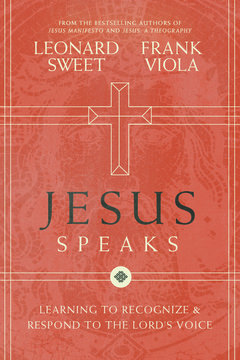
Both articles are a preview to my new book with Leonard Sweet - JESUS SPEAKS: Learning to Recognize & Respond to the Lord's Voice.

It's a unique book that I believe you'll love. The book releases August 9th, but you can pre-order it now.

There's a Sampler on the book website that includes several chapters and the Table of Contents. The book comes in hardcover, Kindle, Nook, and ePub.


The Sampler is also on that page.

     Your brother in His unfailing grace,

     fv

     Psalm 115:1

​​​​​​​ 


Image

John Fenn, Random Thought, Dominion Theology #2

Hi all,
Last week I outlined the basic beliefs of Dominion Theology, also called Kingdom Now, and this week I want to outline some basic differences by looking at the Word.
 
First a review - Dominion Theology (DT) or Kingdom Now (KN) as it is also called, believes God lost control of the earth when Adam sinned, but now through Christ we are called to take dominion over the earth by infiltrating 7 areas of influence, called the '7 mountains'. This is led by 'apostles' in the 7 areas, and those submitted to them are 'overcomers', and having taken dominion in these areas, will present the earth to the Lord upon His return. Those 7 mountains are: Government, education, business, media, arts & entertainment, church and family.
 
While there are variations under the umbrella of Dominion Theology, I've found many who identify themselves with DT or KN don't know what they believe - many are just wrapped up in the prophecies of a new age of prosperity for themselves and the nation and world and that's all they know.
 
There are some variations, but generally here are a few key beliefs:
1) The Tribulation is not taught as a time when anti-Christ will rule and persecute Israel and believers in Jesus, but rather a time of God's judgement on earth brought through His people. Many therefore believe then that anti-Christ isn't a person, but a system, using I John 4:3 to ground their belief, which mentions the spirit of anti-Christ which denies Jesus, is already in the world. Therefore anti-Christ isn't a person, but merely a spirit governing ungodly governments, business, education, media, arts & entertainment, church, and family.
 
2) The church has failed in the last 2,000 years. Jesus came to do the work of the cross, then left the church to take dominion over the earth's 7 mountains listed above. But now we've come to understand the gospel correctly. Jesus told us to be witnesses, demonstrating the kingdom to the world, which means take over the 7 systems of the world to bring His kingdom to fruition as part of our witness. 
 
They often use I Corinthians 15:25-26: "He must reign until He has put all enemies under His feet..." From there they say we are the body of Christ, and even His feet rule over His enemies, therefore as His body we must take dominion over the earth.
 
In order for this to happen we must have the proper church government, which is overcomers submitted to apostolic leaders in the 7 mountains. Once God's government is set, helped along by prayer warriors pulling down strongholds to make the way, then Christians can move into position to take over those 7 areas.
 
3) No rapture. This is explained as a rapturous feeling of joy upon Christ' return.
 
4) The church is Israel. Most would agree the church is spiritual Israel, but Dominion Theology does away with the importance of the nation of Israel altogether, appropriating Old Testament and New Testament verses to mean the body of Christ.
 
5) Emphasis on our prayer to pull down strongholds, and teamwork with angels and those in Christ who have died and are now in heaven in order to usher in heaven on earth. In early stages I saw this thinking in conventions where they said if they just get enough people together to pray, just yell and shout loud enough, God will hear and send revival. Along the way some of it has morphed into making God our adversary, One who must be convinced to send revival, and impressed by numbers of people all praying the same thing.
 
Does the Bible prophesy Christians will dominate the 7 mountains?
Jesus said in Matthew 24:37 the earth will be as in the days of Noah at His return. You may recall Noah wasn't dominating the earth at that point, but was dominated by the ungodly around him. In fact only his family survived the flood.
 
Israel is the point, not the USA
It is clear throughout the whole Bible that Israel is the point, not any other nation including the USA. Jesus said in Luke 21:24 when prophesying of the 70 AD destruction of the temple, that "Jerusalem will be trodden down by the Gentiles until the time of the Gentiles is fulfilled." Israel took control of the city in 1967, marking the start of the end of the time of the Gentiles. It could be argued Israel doesn't directly control east Jerusalem and that Jesus' prophecy has only been partially fulfilled, but either way, it is about literal Israel.
 
Paul said in Romans 11:25-26, "I don't want you to be ignorant nor conceited so I tell you this mystery, that blindness in part has happened to Israel until the full number of Gentiles (non Jews) is fulfilled, then the remnant (of Israel) will be saved." So God is waiting for the maximum number of Gentiles to be saved as possible, and then the end of the focus on Gentiles will come, and His attention will shift to Israel. That isn't spiritual Israel for the sentence wouldn't make sense. Literal Israel is important.
 
The 2 who spoke to Jesus on the Mount of Transfiguration of His upcoming death* were Moses and Elijah, representing the law and the prophets. When Jesus was resurrected He spoke to the 2 on the road to Emmaus* out of Moses (the law) and the prophets. *Luke 9:30-31 and 24:27, 44-45
 
The 2 witnesses in Revelation 11:4-6 are Moses (law) and Elijah (prophets), who have 1) the power to hit the earth with plagues and turn water to blood, and 2) stop the rain from falling. (Which explains why Jude v9 tells us Michael, the Archangel in charge of Israel* took possession of the body of Moses after the Lord Himself buried him** rather than let it decay. *Daniel 12:1 **Deuteronomy 34:5-7
 
In Zechariah 12:10-11 and 13:6 it is prophesied when Messiah returns to the nation of Israel (not a spiritual Israel) they will ask how He got those wounds in His hands and He will tell them 'in the house of my friends'. and they will grieve as one mourns the death of an only child and the death of the firstborn child. There is no way to spiritualize those verses to make them mean 'the church'.
 
Personally speaking
I find it a daily challenge just to walk in the Spirit* in love, joy, peace, gentleness, long suffering, goodness, meekness, faithfulness, self-control, and adding to my faith** virtue, knowledge, patience, godliness, brotherly love, and unconditional love so that I walk in the Spirit and abound in the faith. *Galatians 5:22-25, **II Peter 1:5-8
 
I take my hat off to those who have mastered walking in these things and have time to get caught up in each new 'move of God'. Looking back at 4 decades of 'moves of God' like the charismatic renewal with accompanying goofy personal prophecy, shepherding movement, Word of Faith, prosperity, apostolic, prayer warriors, messianic to the exclusion of New Testament truths, open heaven and go to heaven at will errors, and so many more, that I marvel these people have evidently mastered walking in the Spirit and are now able to move on from walking in the Spirit to pursue such peripheral teachings. I still have my hands full and it takes my full attention just walking with the Father and Lord daily, applause to those who have mastered that and have the luxury of pursuing other teachings.
 
What are we called to?
We are called to be saints, ever-learners (disciples) of Jesus Christ, pursuing only those things and those people that move us deeper into Him. We are also called according to HIS purpose (not ours), called into the fellowship of Jesus Christ, called to the liberty not of the flesh, but called to the liberty of loving one another in Christ, called to fight the fight of faith while laying hold of eternal life, called to be holy, and called out of darkness into the light. (Quoting Romans 1:7, 8:28, I Corinthians 1:9, Galatians 5:13, I Timothy 6:12, II Timothy 1:9, I Peter 2:9)
 
Don't we have our hands full just learning to walk with God through our day? Haven't you noticed all these 'moves of God' and 'fad teachings', rise up quickly and die down just as quickly? Haven't we noticed that just as the hyper-grace teaching fades which took the place of the blood moon craze, and people come back to balance, the Dominion Theology rises to take its place? The Lord allows some immaturity in His body as we do with our own immature children, but eventually every good parent brings the kids back to the path. Concentrate on walking with the Lord, not putting attention to anything which distracts us from our Prime Directive.  
 
New 'random thought' next week, until then, blessings,
    John Fenn
www.cwowi.org and email me at cwowi@aol.com


New CD/MP3 Series
 
David; King in Exile, is the 3rd of a 3 part series looking at the Psalms David wrote at various events in his life. In this series we see the anguish of a father whose son turns against him, and the Psalms where he wrestled with wanting to see justice yet wanting his son saved. We see the intrigue of David's family life and Bathsheba's grandfather, David's closest advisor, and we see victorious David reclaiming his kingdom and purchasing the hill top that would become the Temple Mount, the place of Solomon's temple. And finally, at the end of his life David's Psalms are reflective, looking to God as the Creator to whom he will soon go, and the recounting of God's faithfulness to him down through the years. For anyone who loves someone who isn't walking with the Lord, to one reflecting on God's faithfulness, this series will inspire you!


Minnesota Schedules Training Workshop


The Occasional

Minnesota Schedules Training Workshop
  • Free lodging and materials.  Limited space in this workshop.
  • What if I don’t live in MN?  Not a problem.  Registration is open to everyone, no matter where you live. If fact, if you are from out of state, you play a key role in pioneering Simple Church planting in new areas.
    No matter where you are from, try to bring one other family with you who shares your missionary heart. Come – as an individual, as a family, as a team.
  • Registration deadline is September 8thwww.SimpleChurchTrainingWorkshops.com 

Jumat, 15 Juli 2016

How Do You Become a Sending Church?

How Do You Become a Sending Church?
This week, Exponential took a look at how church plants can become church planting churches. Here are the resources released this week:
  • What it Takes to Become a Sending Church | podcast from Ron Tobias | listen here
  • Developing a Culture of Sending | video from J.D. Greear | watch here
  • From Church to Movement - Making the Transition | podcast from Steve Addison & Troy Cooper | listen here
  • What the Global Church Taught Bob Roberts About Church Planting | article from Chad Harrington | read here